Silicone-Fiberglass Fabric Market Outlook 2026–2034: High-Temperature Insulation, Fire Protection Demand, Growth Drivers, Leading Companies, and Future Opportunities
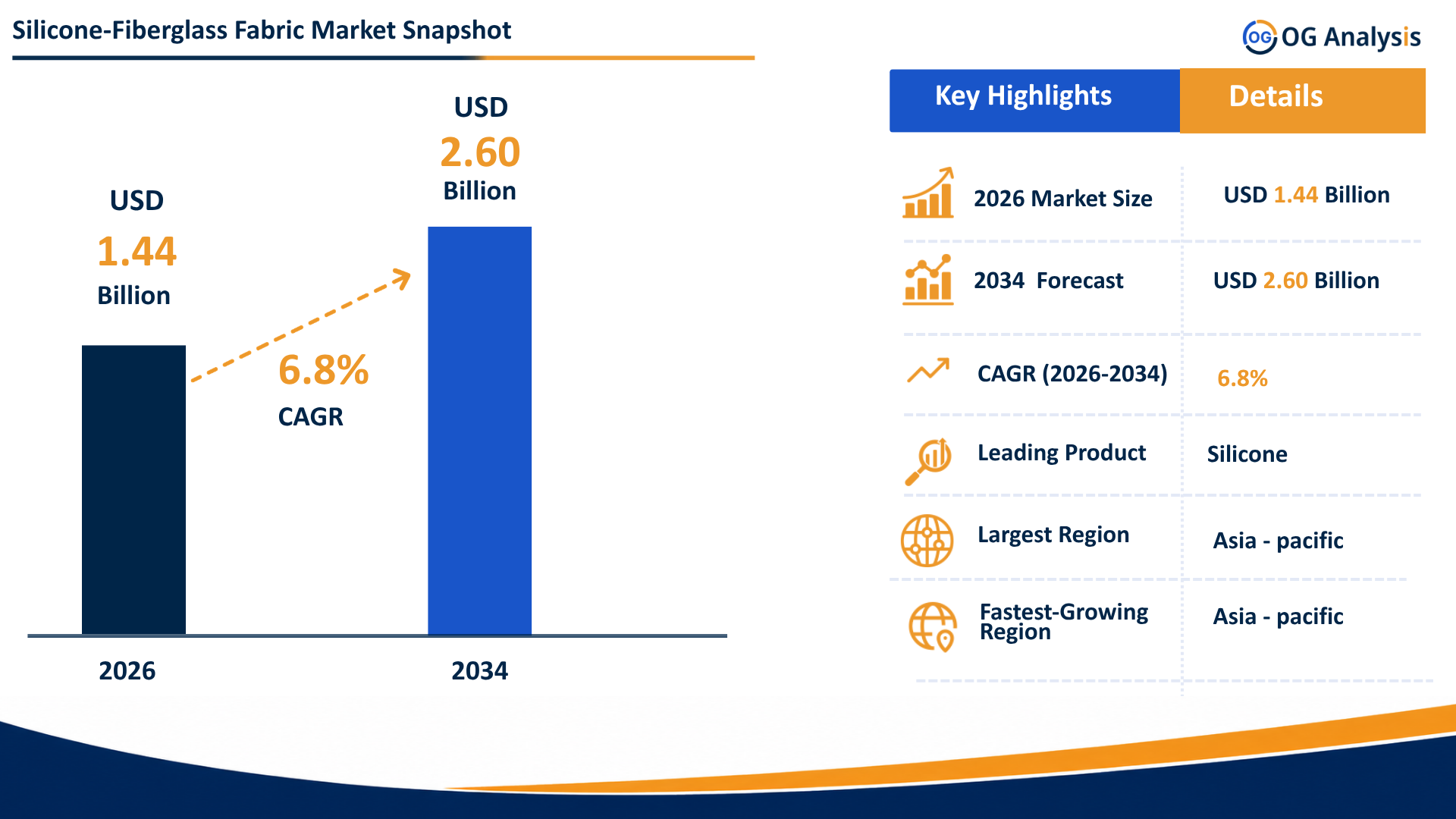
The Silicone-Fiberglass Fabric Market is estimated to be valued at $ 1.44 billion in 2026 and is projected to reach $ 2.60 billion by 2034, expanding at a CAGR of 6.8% from 2026 to 2034.
Silicone-fiberglass fabric is a technical textile made by coating woven fiberglass substrate with silicone rubber to provide heat resistance, flame resistance, weatherability, flexibility, chemical resistance, electrical insulation, and mechanical durability. These fabrics are used in insulation covers, expansion joints, welding blankets, fire curtains, conveyor belts, removable insulation jackets, electrical insulation, protective covers, gaskets, seals, and industrial safety products. Market growth is supported by rising demand for high-temperature protective materials in aerospace, automotive, construction, manufacturing, electrical, marine, oil and gas, chemical processing, and power-generation applications. The material is preferred where conventional textiles cannot withstand heat, sparks, abrasion, moisture, oils, chemicals, or outdoor exposure. Product innovation is focused on one-sided and two-sided coatings, high-temperature grades, flame-retardant fabrics, lightweight insulation materials, custom thicknesses, flexible laminates, and application-specific coated fiberglass solutions.
Get the Complete Analysis :
https://www.oganalysis.com/industry-reports/siliconefiberglass-fabric-market
Get Your Free Sample Report for In-Depth Market Insights :
https://www.oganalysis.com/industry-reports/siliconefiberglass-fabric-market/free-sample
1. What is the latest trend in the Silicone-Fiberglass Fabric Market?
The latest trend is the increasing use of silicone-coated fiberglass fabrics in high-temperature insulation, fire protection, and industrial safety applications.
Manufacturers are offering one-sided and two-sided coated fabrics with improved flexibility, tear resistance, weather resistance, and flame-retardant performance.
Demand is also increasing for removable insulation blankets, welding protection, thermal barriers, and customized protective covers.
Application-specific coated fabrics are gaining importance as users require materials tailored for heat, abrasion, chemical exposure, and outdoor durability.
2. What are the key challenges in the Silicone-Fiberglass Fabric Market?
Key challenges include raw material price volatility, coating-quality consistency, competition from PTFE, aluminized, acrylic, and other high-performance fabrics.
Manufacturers must balance heat resistance, flexibility, coating adhesion, tensile strength, weight, thickness, and cost.
End users also require consistent flame resistance, weatherability, dielectric performance, and long-term durability under demanding operating conditions.
Price-sensitive customers may shift to lower-cost coated fabrics when extreme temperature or chemical resistance is not required.
3. What is the major driving factor for the Silicone-Fiberglass Fabric Market?
The major driving factor is rising demand for durable heat-resistant and fire-protection materials across industrial and infrastructure applications.
Silicone-fiberglass fabrics help protect equipment, workers, pipes, ducts, cables, machinery, and structures from heat, sparks, flame, moisture, and abrasion.
Growth in industrial insulation, manufacturing safety, automotive heat shielding, aerospace thermal protection, and construction fireproofing is strengthening demand.
Stricter workplace safety practices and higher performance expectations for technical textiles are further supporting market expansion.
4. What is the major segment in the Silicone-Fiberglass Fabric Market and why?
Silicone-coated fiberglass fabric is the major product segment because it offers a strong balance of heat resistance, flexibility, insulation, and mechanical strength.
Two-sided coated fabrics are widely used where both surfaces require protection against heat, moisture, chemicals, and abrasion.
One-sided coated fabrics are preferred where users need lower weight, flexibility, or cost efficiency with protection on one working surface.
Silicone rubber fabric grades are also important for sealing, gasketing, insulation jackets, and custom fabricated industrial components.
5. Which application or end-user is driving more demand?
Industrial insulation, fireproofing, automotive heat protection, aerospace insulation, electrical protection, and construction safety are driving strong demand.
Manufacturers use these fabrics in removable insulation jackets, expansion joints, fire curtains, welding blankets, conveyor covers, and equipment protection.
Automotive and aerospace users require lightweight thermal barriers and heat-resistant covers for components exposed to high temperatures.
Electrical, chemical, marine, and oil and gas users value silicone-fiberglass fabric for insulation, protection, and durability in harsh operating environments.
6. Which region offers the highest growth potential and why?
Asia Pacific offers strong growth potential due to industrial manufacturing growth, construction activity, automotive production, electronics manufacturing, and expanding technical textile capacity.
China, India, Japan, South Korea, and Southeast Asia are important markets for coated fabrics, industrial insulation, and protective textile products.
North America remains important due to aerospace, industrial safety, oil and gas, construction, and high-performance materials demand.
Europe is supported by strict safety standards, advanced manufacturing, automotive engineering, and demand for specialty coated technical textiles.
7. What strategies are major companies adopting in the market?
Major companies are focusing on advanced coating technology, custom fabric weights, wider temperature ranges, improved flame resistance, and fabricated finished products.
They are expanding solutions for insulation jackets, welding blankets, fire curtains, expansion joints, conveyor belts, and protective covers.
Suppliers are also improving coating uniformity, roll width, thickness control, tensile strength, and compatibility with cutting, sewing, and fabrication processes.
Partnerships with industrial distributors, fabricators, OEMs, and safety-equipment suppliers are helping companies increase market reach.
8. What are the leading companies in the Silicone-Fiberglass Fabric Market?
Leading companies include Trelleborg, Saint-Gobain Performance Plastics, Mid-Mountain Materials, Wacker Chemie, 3M, Sioen Industries, Arlon Silicone Technologies, Auburn Manufacturing, Newtex Industries, Fothergill Group, PAR Group, VITCAS, Fiberflon, McAllister Mills, and Texpack.
These companies compete through coating quality, heat resistance, flame protection, material consistency, fabrication support, certification, and application-specific product development.
Specialized suppliers serve high-temperature insulation, welding protection, aerospace, marine, construction, and industrial safety applications.
Companies with strong technical support and custom-converted fabric capabilities are better positioned in high-performance end-use markets.
9. Why is silicone-fiberglass fabric strategically important for industrial users?
Silicone-fiberglass fabric is strategically important because it protects people, equipment, and infrastructure in high-temperature and fire-risk environments.
It supports safer welding, insulation, machinery protection, electrical insulation, and thermal shielding applications.
For industrial operators, the material helps reduce heat damage, maintenance frequency, downtime, and safety risks.
For fabricators and OEMs, it enables customized protective products that meet demanding thermal, mechanical, and environmental requirements.
10. What is the future outlook for the Silicone-Fiberglass Fabric Market?
The market outlook remains positive as demand grows for heat-resistant, flame-retardant, weatherable, and flexible protective textile materials.
Future growth will be supported by industrial insulation, aerospace and automotive heat management, electrical safety, construction fireproofing, and marine protection applications.
Product development will focus on lighter fabrics, stronger coatings, better flexibility, improved durability, and sustainable manufacturing practices.
Companies offering reliable performance, customized grades, strong fabrication support, and cost-effective technical textile solutions are expected to gain market share.
Browse Related Reports
https://www.oganalysis.com/industry-reports/sustainable-building-insulation-market
https://www.oganalysis.com/industry-reports/fire-retardant-heat-shrink-tubing-market
https://www.oganalysis.com/industry-reports/industrial-rubber-market
