Vendor Neutral Archive (VNA) & PACS Market Outlook 2026–2034: Cloud Imaging Adoption, Enterprise PACS Modernization, Growth Drivers, Leading Companies, and Future Opportunities
The Vendor Neutral Archive (VNA) & PACS Market is estimated to be valued at $ 5.67 billion in 2026 and is projected to reach $ 11.39 billion by 2034, expanding at a CAGR of 9.1% from 2026 to 2034.
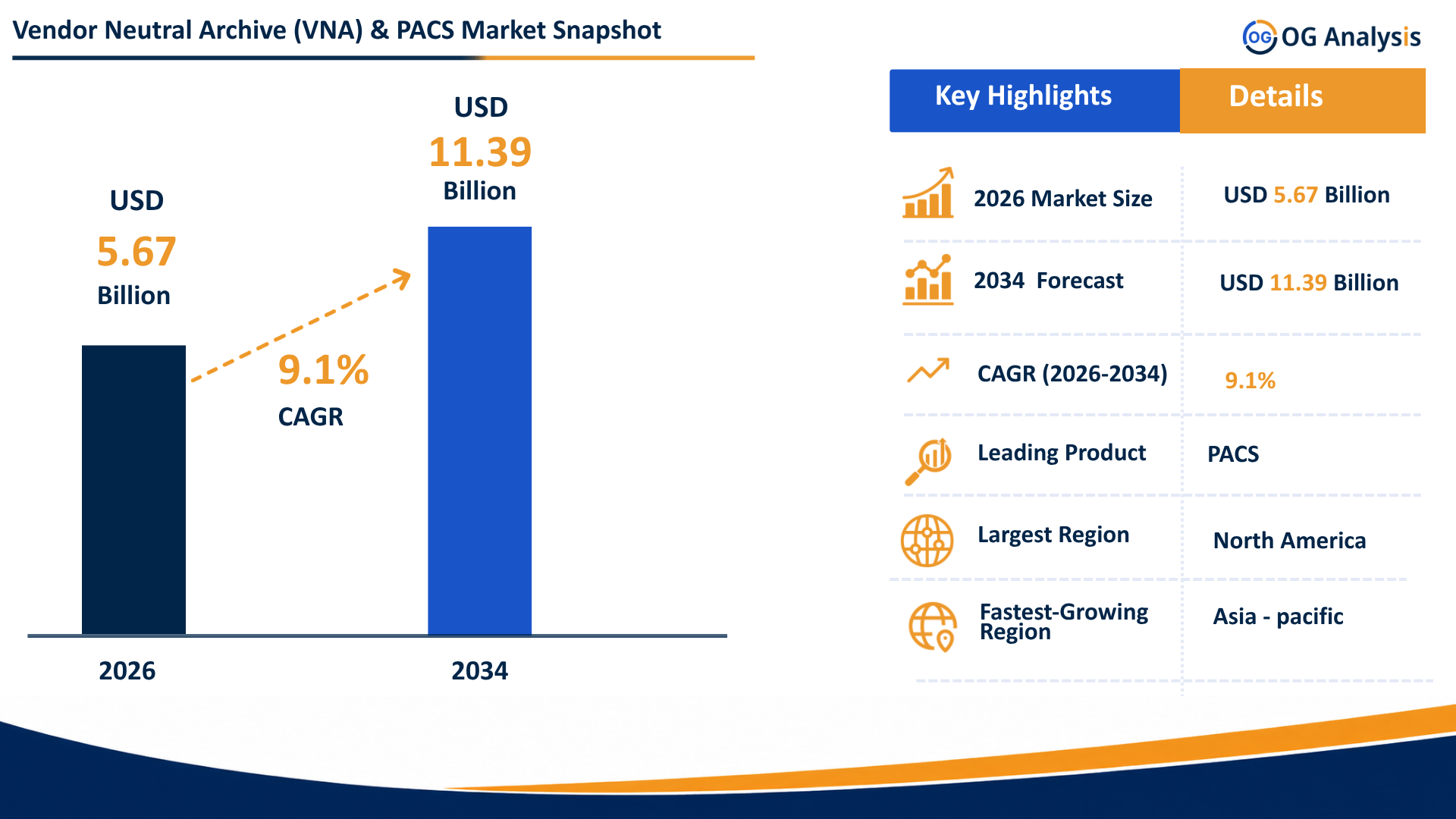
Vendor Neutral Archive solutions store, manage, standardize, and share medical images and related clinical content across departments and healthcare systems, while Picture Archiving and Communication Systems support image capture, viewing, workflow management, reporting integration, and radiology operations. Market growth is supported by rising medical imaging volumes, hospital digital transformation, enterprise imaging strategies, cloud adoption, interoperability requirements, and demand for faster access to patient imaging records. Healthcare providers are replacing fragmented departmental PACS environments with integrated VNA and enterprise imaging platforms to improve data sharing across radiology, cardiology, oncology, orthopedics, pathology, and emergency care. Cloud-native PACS, AI-ready imaging archives, cybersecurity, regulatory compliance, and multi-site collaboration are becoming central to purchasing decisions.
Get the Complete Analysis :
https://www.oganalysis.com/industry-reports/vendor-neutral-archive-vna--pacs-market
Get Your Free Sample Report for In-Depth Market Insights :
https://www.oganalysis.com/industry-reports/vendor-neutral-archive-vna--pacs-market/free-sample
1. What is the latest trend in the Vendor Neutral Archive (VNA) & PACS Market?
The latest trend is the shift toward cloud-based PACS and VNA platforms that support enterprise-wide image access, remote reading, and scalable storage.
Healthcare organizations are adopting vendor-neutral imaging archives to reduce dependence on single-vendor PACS environments.
AI-enabled image analytics, DICOMweb, zero-footprint viewers, and web-based radiology workflows are gaining adoption.
Multi-site healthcare networks are also prioritizing secure image sharing, disaster recovery, and centralized imaging data management.
2. What are the key challenges in the Vendor Neutral Archive (VNA) & PACS Market?
Key challenges include data migration complexity, legacy PACS integration, cybersecurity risk, storage cost, interoperability gaps, and long implementation timelines.
Hospitals must manage large volumes of DICOM and non-DICOM data from multiple imaging modalities and departments.
System downtime, image retrieval speed, regulatory compliance, and user training are also important concerns.
Vendors must ensure compatibility with EHR, RIS, cardiology systems, AI tools, cloud platforms, and existing clinical workflows.
3. What is the major driving factor for the Vendor Neutral Archive (VNA) & PACS Market?
The major driving factor is the rapid growth of medical imaging data and the need for interoperable image management across healthcare systems.
Hospitals, diagnostic centers, and imaging networks require reliable storage, fast retrieval, and secure sharing of patient images.
VNA platforms help consolidate imaging data from multiple PACS and improve access across departments.
Cloud PACS and enterprise imaging systems also support remote radiology, teleradiology, and multi-location care delivery.
4. What is the major segment in the Vendor Neutral Archive (VNA) & PACS Market and why?
PACS remains a major segment because it is the core imaging workflow platform used for radiology image storage, viewing, distribution, and interpretation.
Radiology departments depend on PACS for day-to-day reading, workflow management, reporting integration, and image availability.
VNA is gaining strong importance because it enables long-term, vendor-neutral storage and enterprise-wide access to imaging data.
Cloud-based VNA and PACS solutions are among the fastest-growing segments due to scalability, remote access, and lower infrastructure burden.
5. Which application or end-user is driving more demand?
Hospitals and health systems are the leading demand drivers because they generate large imaging volumes across radiology, cardiology, oncology, emergency care, and surgery.
Diagnostic imaging centers use PACS and VNA platforms to manage CT, MRI, ultrasound, X-ray, mammography, PET, and other imaging studies.
Teleradiology providers and multi-site healthcare networks require fast, secure, and centralized image access.
Academic hospitals and research institutions also use imaging archives to support clinical research, AI training, and longitudinal patient data analysis.
6. Which region offers the highest growth potential and why?
North America remains a leading market due to advanced healthcare IT adoption, high imaging procedure volumes, and strong demand for enterprise imaging platforms.
Europe is supported by hospital digitization, cross-site image sharing, data protection requirements, and modernization of public healthcare imaging infrastructure.
Asia Pacific offers strong growth potential due to expanding healthcare infrastructure, growing diagnostic imaging demand, and rising investment in digital hospitals.
China, India, Japan, South Korea, Australia, and Southeast Asia are important markets for PACS upgrades, cloud imaging, and diagnostic center expansion.
7. What strategies are major companies adopting in the market?
Major companies are focusing on cloud-native PACS, enterprise imaging platforms, AI-ready archives, cybersecurity, and interoperability with EHR and clinical systems.
They are developing zero-footprint viewers, web-based access, automated workflow tools, and advanced image lifecycle management.
Vendors are also strengthening partnerships with hospitals, cloud providers, AI companies, and diagnostic imaging equipment manufacturers.
Service models are shifting toward subscription-based, managed-service, and hybrid-cloud deployments to reduce customer infrastructure burden.
8. What are the leading companies in the Vendor Neutral Archive (VNA) & PACS Market?
Leading companies include GE HealthCare, Philips, FUJIFILM, Sectra, Agfa HealthCare, Siemens Healthineers, Merative, Hyland Healthcare, Intelerad, Change Healthcare, Canon Medical Systems, Carestream Health, Novarad, RamSoft, Dicom Systems, BridgeHead Software, Dell Technologies, Mach7 Technologies, and Visage Imaging.
These companies compete through archive scalability, viewer performance, cloud deployment, interoperability, workflow tools, AI integration, cybersecurity, and implementation support.
Major VNA market participants commonly include GE HealthCare, Siemens Healthineers, FUJIFILM, Philips, Merative, Hyland Healthcare, Sectra, Agfa HealthCare, Carestream, Canon Medical Systems, Novarad, Intelerad, and RamSoft.
Vendors with strong enterprise imaging portfolios and cloud migration capability are better positioned as hospitals consolidate imaging systems.
9. Why are VNA and PACS strategically important for healthcare providers?
VNA and PACS are strategically important because they form the digital backbone of medical imaging operations.
They help clinicians access patient images quickly, support faster diagnosis, reduce duplicate imaging, and improve care coordination.
For hospital networks, vendor-neutral archives reduce data silos and make imaging information available across departments and locations.
For healthcare IT teams, modern platforms support better governance, disaster recovery, cybersecurity, and long-term image lifecycle management.
10. What is the future outlook for the Vendor Neutral Archive (VNA) & PACS Market?
The market outlook remains positive as healthcare systems continue moving toward cloud imaging, enterprise imaging, AI-enabled diagnostics, and interoperable clinical data platforms.
Future growth will be supported by cloud-based PACS, vendor-neutral archives, AI workflow integration, remote reading, cybersecurity, and multi-site image exchange.
Demand will continue across hospitals, diagnostic imaging centers, teleradiology providers, ambulatory care networks, and academic medical institutions.
Companies offering secure, scalable, AI-ready, and workflow-integrated VNA and PACS solutions are expected to gain market share.
Browse Related Reports
https://www.oganalysis.com/industry-reports/nuclear-medicine-market
https://www.oganalysis.com/industry-reports/laboratory-information-system-lis-market
https://www.oganalysis.com/industry-reports/iot-medical-devices-market
https://www.oganalysis.com/industry-reports/cloud-analytics-market
https://www.oganalysis.com/industry-reports/clinical-trial-imaging-market
