Agritech Market Outlook 2026–2034: AI Innovation, Precision Farming, Leading Companies, and Growth Opportunities
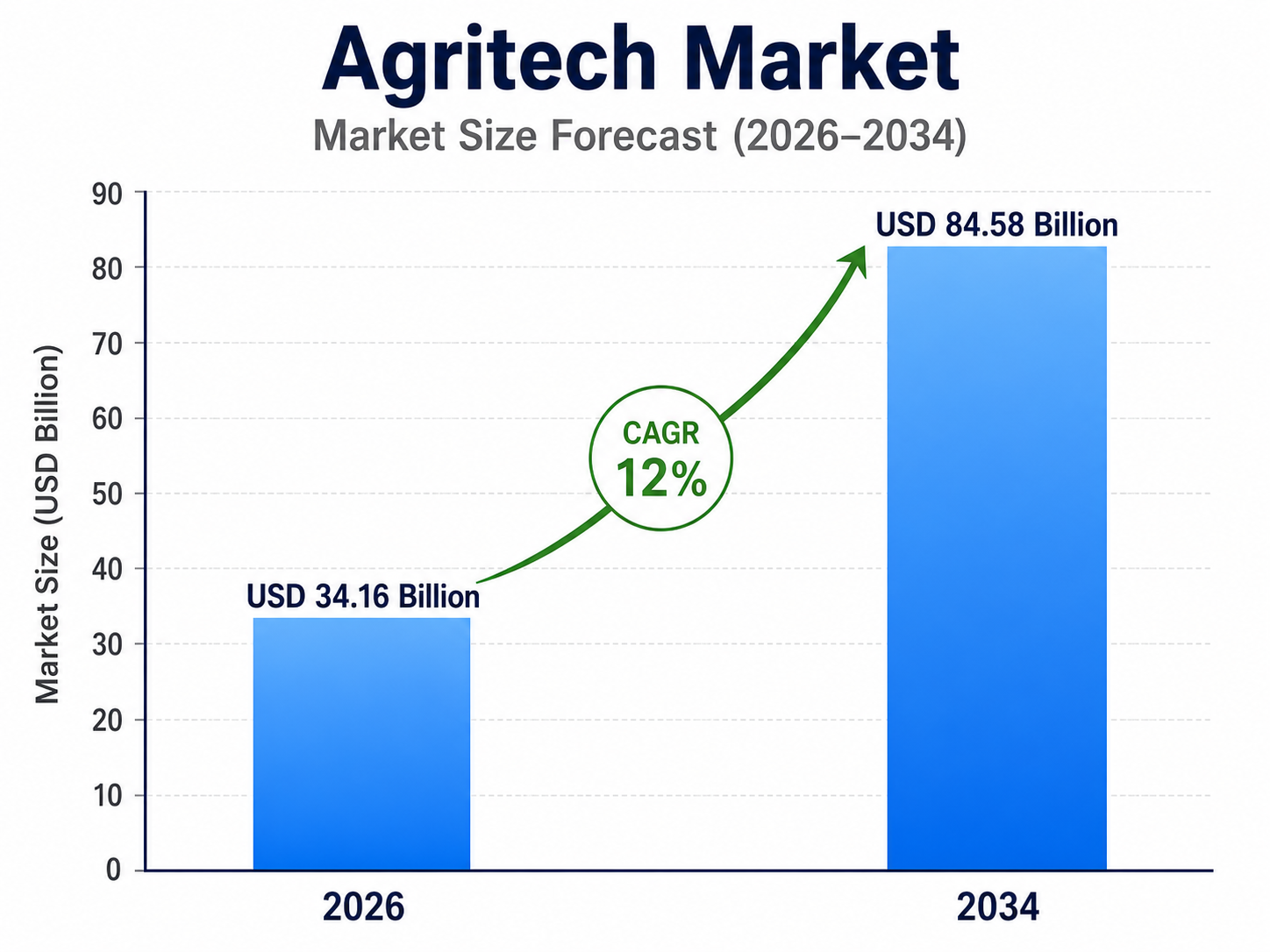
The Agritech Market is estimated to be valued at $ 34.16 billion in 2026 and is projected to reach $ 84.58 billion by 2034, expanding at a CAGR of 12% from 2026 to 2034.
Agritech includes hardware, software, digital platforms, sensors, drones, robotics, satellite imaging, biotechnology, connected machinery, and data analytics used to improve agricultural productivity and resource efficiency. These technologies support precision farming, crop monitoring, irrigation management, livestock tracking, farm automation, input optimization, supply-chain traceability, and agricultural finance. Market growth is driven by rising food demand, labor shortages, climate variability, water scarcity, and the need to reduce fertilizer, pesticide, and energy consumption. Farmers, agribusinesses, equipment manufacturers, food companies, and governments are increasingly investing in connected and data-driven agricultural systems. As farming becomes more automated and climate-focused, agritech is becoming central to productivity, sustainability, risk management, and food security.
1. What is the latest trend in the Agritech Market?
The latest trend is the integration of generative AI, machine vision, robotics, drones, satellite data, and IoT sensors into unified farm-management platforms.
Farmers are using these technologies for crop-health analysis, yield forecasting, autonomous operations, and site-specific input application.
AI-based advisory tools are also becoming more accessible to small and medium-sized farms.
The market is shifting from standalone devices toward connected agricultural ecosystems.
2. What are the key challenges in the Agritech Market?
Key challenges include high upfront investment, limited rural connectivity, fragmented farm structures, data-ownership concerns, and uncertain returns on investment.
Farmers may also face difficulties integrating equipment, software, sensors, and platforms from different suppliers.
Limited technical skills and weak after-sales support can slow adoption in developing regions.
Technology providers must demonstrate affordability, reliability, and measurable farm-level benefits.
3. What is the major driving factor for the Agritech Market?
The major driving factor is the need to produce more food while using less land, water, labor, fertilizer, and crop-protection inputs.
Climate change and increasingly unpredictable weather are creating demand for real-time monitoring and decision-support tools.
Labor shortages are encouraging adoption of automated machinery, robots, and remotely operated equipment.
Government digital-agriculture programs and sustainability targets provide additional support.
4. What is the major segment in the Agritech Market and why?
Precision agriculture represents a major segment because it combines sensors, GPS, analytics, connected machinery, and variable-rate application.
These solutions help farmers apply seeds, water, fertilizer, and pesticides according to field-level requirements.
Precision farming can improve yields while reducing waste, environmental impact, and operating costs.
Its relevance across crops, farm sizes, and geographic regions supports broad adoption.
5. Which application or end-user is driving more demand?
Crop farming is driving significant demand, particularly across cereals, oilseeds, horticulture, fruits, vegetables, and high-value specialty crops.
Large farms use agritech to improve machinery utilization, input efficiency, and production planning.
Smallholders are increasingly adopting mobile advisory services, digital marketplaces, satellite monitoring, and shared equipment platforms.
Livestock, aquaculture, and controlled-environment agriculture also represent expanding application areas.
6. Which region offers the highest growth potential and why?
Asia Pacific offers strong growth potential due to its large agricultural population, food demand, digital adoption, and government modernization programs.
China, India, Japan, Australia, South Korea, and Southeast Asia are investing in drones, smart irrigation, farm mechanization, and digital platforms.
North America remains an established market because of large farms and advanced precision-agriculture adoption.
Europe also generates demand through sustainability regulations and input-reduction targets.
7. What strategies are major companies adopting in the market?
Major companies are building integrated platforms that combine machinery, sensors, software, agronomy, connectivity, and financial services.
They are using acquisitions and partnerships to expand AI, satellite analytics, robotics, and farm-management capabilities.
Subscription models, outcome-based services, equipment leasing, and dealer-supported digital solutions are becoming more common.
Companies are also localizing products for different crops, farm sizes, climates, and connectivity conditions.
8. What are the leading companies in the Agritech Market?
Leading companies include Deere & Company, Trimble, AGCO, CNH Industrial, Kubota, Topcon, Bayer, BASF, Corteva Agriscience, Syngenta, DJI, Indigo Agriculture, and Farmers Business Network.
These companies compete across connected machinery, precision agriculture, farm software, crop science, drones, analytics, and digital marketplaces.
Large equipment manufacturers benefit from established dealer and service networks.
Technology-focused firms compete through software usability, data intelligence, and specialized farm applications.
9. Why is agritech strategically important for farmers and agribusinesses?
Agritech helps farmers improve productivity, control input costs, reduce operational risk, and respond more effectively to weather and crop conditions.
For agribusinesses, it supports supply forecasting, traceability, quality control, and stronger relationships with producers.
Digital tools can also improve access to credit, insurance, inputs, markets, and technical advice.
Agritech is therefore becoming a strategic foundation for resilient and transparent food systems.
10. What is the future outlook for the Agritech Market?
The market outlook remains strong as agriculture becomes increasingly automated, connected, data-driven, and climate-focused.
Future growth will be supported by autonomous equipment, agricultural robots, AI agronomy, biological inputs, smart irrigation, and satellite intelligence.
Affordable digital tools are expected to expand adoption among smaller farms and emerging markets.
Companies offering interoperable, practical, scalable, and clearly measurable solutions are likely to gain market share.
Browse Related Reports
https://www.oganalysis.com/industry-reports/plant-growth-regulators-market
https://www.oganalysis.com/industry-reports/controlled-release-fertilizer-market
https://www.oganalysis.com/industry-reports/milking-automation-market
https://www.oganalysis.com/industry-reports/egg-collecting-machine-market
https://www.oganalysis.com/industry-reports/egg-sorting-machine-market
