Glass Container Market Outlook 2026–2034: Sustainable Packaging Demand, Glass Bottle Innovation, Growth Drivers, Leading Companies, and Future Opportunities
The Glass Container Market is estimated to be valued at 43.23 billion in 2026 and is projected to reach $ 73.98 billion by 2034, expanding at a CAGR of 6.94% from 2026 to 2034.
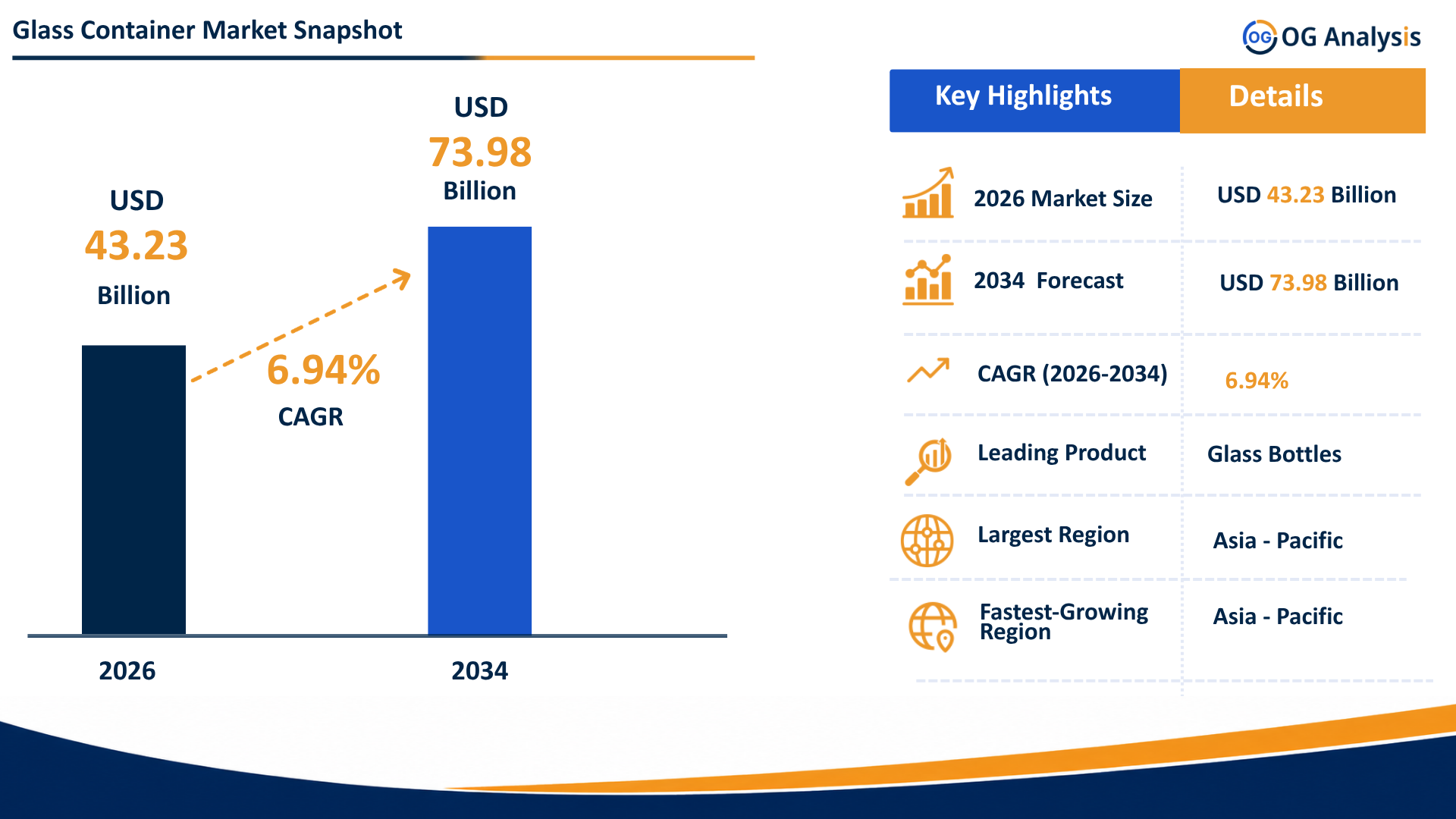
Glass containers are rigid packaging products used to store, protect, preserve, transport, and present food, beverages, pharmaceuticals, cosmetics, personal care products, chemicals, and specialty liquids. Major product types include bottles, jars, vials, ampoules, flacons, cosmetic containers, and specialty glass packaging formats. Market growth is supported by rising demand for sustainable packaging, premium product presentation, recyclable materials, food safety, chemical inertness, and longer product shelf life. Glass containers are widely used in alcoholic beverages, soft drinks, juices, sauces, dairy products, baby food, pharmaceuticals, perfumes, cosmetics, and specialty food products. Demand is also shaped by lightweight glass innovation, returnable bottle systems, recycled cullet use, premium branding, and stricter packaging sustainability requirements.
Get the Complete Analysis :
https://www.oganalysis.com/industry-reports/glass-container-market
Get Your Free Sample Report for In-Depth Market Insights :
https://www.oganalysis.com/industry-reports/glass-container-market/free-sample
1. What is the latest trend in the Glass Container Market?
The latest trend is the shift toward lightweight, recyclable, reusable, and premium glass packaging.
Brands are using glass containers to improve shelf appeal, support sustainability claims, and protect product taste, aroma, purity, and quality.
Beverage, food, cosmetics, and pharmaceutical companies are increasingly using premium glass formats for differentiation.
Glass producers are also investing in hybrid furnaces, lower-carbon production, recycled glass use, and energy-efficient manufacturing.
2. What are the key challenges in the Glass Container Market?
Key challenges include high energy consumption, transportation cost, glass breakage risk, furnace investment, and raw material price volatility.
Glass containers are heavier than plastic or metal alternatives, which can increase logistics cost and carbon footprint if supply chains are not optimized.
Manufacturers must balance strength, lightweighting, clarity, mold quality, recyclability, and cost efficiency.
Competition from PET bottles, aluminum cans, flexible packaging, and cartons also affects adoption in price-sensitive applications.
3. What is the major driving factor for the Glass Container Market?
The major driving factor is rising demand for sustainable and premium rigid packaging.
Glass is widely valued because it is recyclable, chemically inert, non-reactive, and suitable for preserving flavor, fragrance, purity, and product integrity.
Food, beverage, pharmaceutical, and cosmetics brands use glass containers to improve consumer trust and product positioning.
Growth in alcoholic beverages, specialty foods, premium cosmetics, and pharmaceutical packaging is strengthening demand.
4. What is the major segment in the Glass Container Market and why?
Bottles represent a major product segment because they are widely used across beer, wine, spirits, soft drinks, juices, dairy beverages, sauces, oils, and pharmaceutical liquids.
Glass bottles provide strong barrier protection, premium appearance, and compatibility with returnable and recyclable packaging systems.
Jars and containers are also important due to their use in food products such as sauces, spreads, pickles, baby food, and preserved foods.
Vials and ampoules remain critical in pharmaceutical packaging where sterility, stability, and product compatibility are essential.
5. Which application or end-user is driving more demand?
Food and beverages are driving the strongest demand for glass containers.
Beer, wine, spirits, juices, sauces, condiments, dairy products, and premium food brands rely heavily on glass packaging for protection and branding.
Pharmaceutical companies use glass vials, ampoules, and bottles for injectable drugs, liquid medicines, vaccines, and laboratory products.
Cosmetics and personal care brands use glass containers for perfumes, creams, serums, oils, and luxury skincare products.
6. Which region offers the highest growth potential and why?
Asia Pacific offers strong growth potential due to rising packaged food consumption, beverage demand, pharmaceutical manufacturing, and premium personal care growth.
China, India, Japan, South Korea, and Southeast Asia are important markets due to expanding consumer goods production and retail modernization.
Europe remains a major market due to strong glass recycling systems, premium beverage packaging, and sustainability-focused regulation.
North America is supported by beverage packaging, food brands, pharmaceutical demand, and premium personal care products.
7. What strategies are major companies adopting in the market?
Major companies are focusing on lightweight glass, recycled-content usage, furnace modernization, premium bottle design, and low-carbon manufacturing.
They are expanding product portfolios across beverage bottles, food jars, pharma containers, cosmetics packaging, and specialty glass formats.
Suppliers are also improving forming technology, decoration, embossing, color options, closure compatibility, and returnable bottle designs.
Partnerships with beverage brands, food companies, pharmaceutical firms, cosmetics companies, and recycling networks are becoming important for growth.
8. What are the leading companies in the Glass Container Market?
Leading companies include O-I Glass, Ardagh Group, Verallia, Vidrala, Vetropack, Stoelzle Glass Group, BA Glass, Gerresheimer, Schott, Nihon Yamamura Glass, Toyo Glass, Piramal Glass/AGI Greenpac, Berlin Packaging, and Heinz-Glas.
These companies compete through manufacturing scale, product design, recycled glass use, sustainability performance, customer relationships, and regional plant networks.
O-I Glass, Ardagh, Verallia, Vetropack, and Schott are identified among major glass packaging companies in recent market coverage.
9. Why are glass containers strategically important for packaging companies?
Glass containers are strategically important because they combine product protection, premium appearance, recyclability, and strong consumer trust.
They help brands preserve taste, aroma, freshness, chemical stability, and product purity across sensitive applications.
For beverage and food companies, glass supports premium branding, reusable bottle systems, and sustainability messaging.
For packaging suppliers, glass containers create value through design customization, decoration, lightweighting, and specialty formats.
10. What is the future outlook for the Glass Container Market?
The market outlook remains positive as demand grows for sustainable, premium, recyclable, and product-safe packaging.
Future growth will be supported by lightweight bottles, recycled cullet use, returnable glass systems, premium cosmetics packaging, pharmaceutical vials, and food-grade jars.
Energy efficiency and decarbonized glass production will become increasingly important as manufacturers reduce emissions from furnace operations.
Companies offering reliable supply, innovative designs, lower-carbon production, and strong recycling integration are expected to gain market share.
Browse Related Reports
https://www.oganalysis.com/industry-reports/collapsible-metal-tubes-market
https://www.oganalysis.com/industry-reports/cyclic-olefin-copolymers-market
https://www.oganalysis.com/industry-reports/oxygen-barrier-materials-market
https://www.oganalysis.com/industry-reports/paper-and-paperboard-packaging-market
https://www.oganalysis.com/industry-reports/borosilicate-glass-market
