Industrial Garnet Market Outlook 2026–2034: Waterjet Cutting Trends, Abrasive Blasting Demand, Leading Companies, and Future Opportunities
The Industrial Garnet Market is estimated to be valued at $ 576.2 Million in 2026 and is projected to reach $ 927.4 Million billion by 2034, expanding at a CAGR of 6.13% from 2026 to 2034.
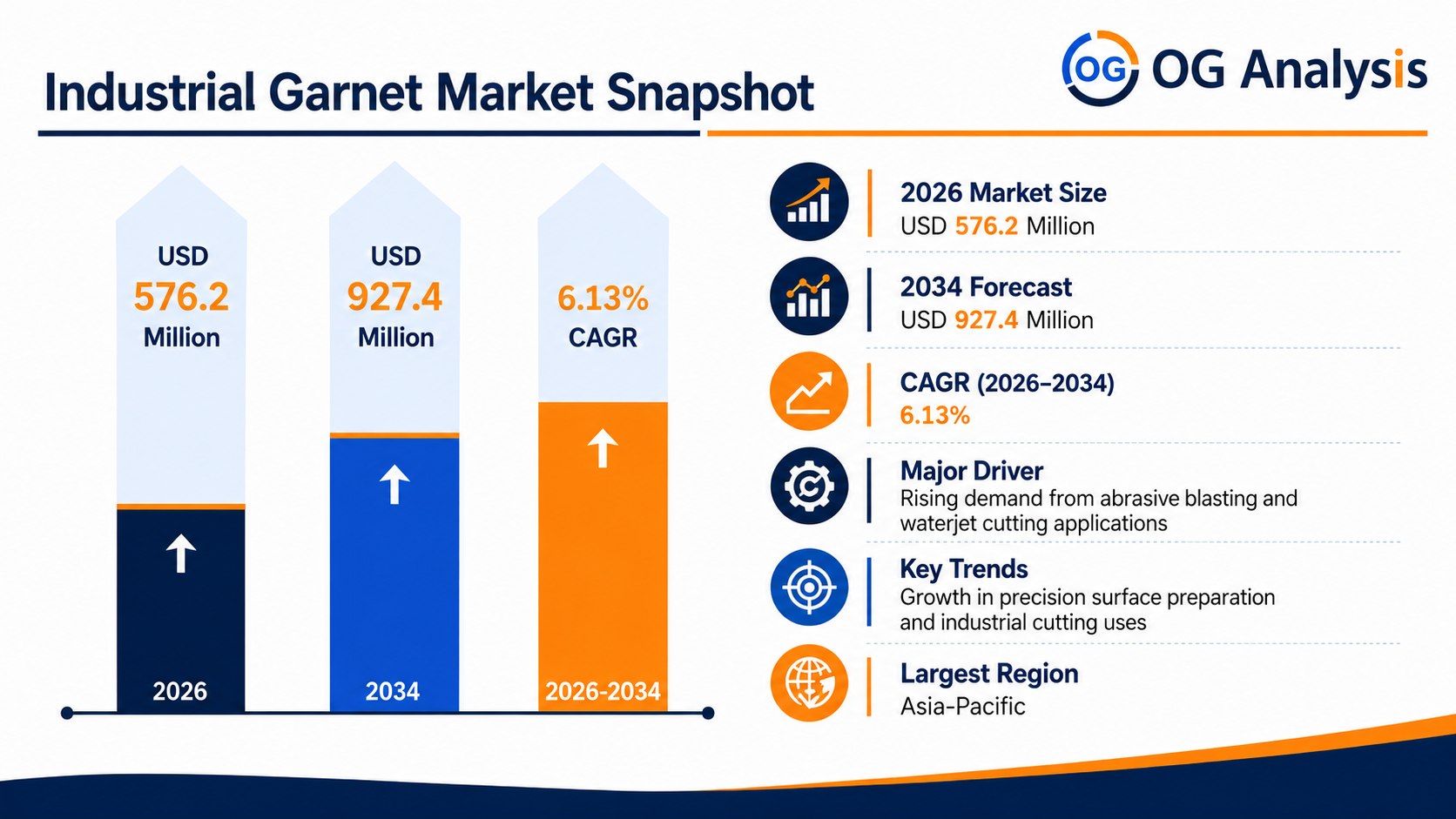
Industrial garnet is a naturally occurring abrasive mineral widely used in waterjet cutting, abrasive blasting, water filtration, abrasive powders, and surface preparation applications. Its hardness, angular grain structure, chemical stability, recyclability, and relatively low dust generation make it suitable for precision cutting, cleaning, and finishing across manufacturing and infrastructure industries. Market growth is supported by rising demand from metal fabrication, shipbuilding, aerospace, automotive, construction, oil and gas, and water treatment sectors. Product development is focused on consistent grain sizing, low chloride content, higher cutting efficiency, reusable abrasive grades, and environmentally safer alternatives to silica sand and slag-based abrasives.
Get Your Free Sample Report for In-Depth Market Insights :
https://www.oganalysis.com/industry-reports/industrial-garnet-market
1. What is the latest trend in the Industrial Garnet Market?
The latest trend is the increasing adoption of high-performance garnet abrasives for precision waterjet cutting and environmentally safer abrasive blasting.
Customers are seeking garnet grades with consistent particle size, lower dust generation, better recyclability, and improved cutting speed.
Demand is also rising for recycled garnet and optimized abrasive blends that reduce waste and operating cost.
This trend is supporting premium grades used in aerospace, automotive, metal fabrication, and advanced manufacturing.
2. What are the key challenges in the Industrial Garnet Market?
Key challenges include mining restrictions, fluctuating raw material availability, transportation costs, quality variation, and price competition from alternative abrasives.
Industrial users require consistent hardness, purity, mesh size, and low contamination levels for reliable cutting and blasting performance.
Supply concentration in selected mining regions can create logistics and procurement risks.
Competition from steel grit, coal slag, copper slag, silica sand substitutes, and synthetic abrasives can also pressure margins.
3. What is the major driving factor for the Industrial Garnet Market?
The major driving factor is rising demand for efficient, durable, and cleaner abrasive materials in industrial cutting and surface preparation.
Garnet is widely preferred in waterjet cutting because it supports precise, cold cutting of metals, stone, ceramics, glass, and composites.
In blasting, it helps remove rust, coatings, and contaminants while producing relatively lower dust than several traditional abrasives.
Growth in manufacturing, ship repair, infrastructure maintenance, and fabrication industries is strengthening demand.
4. What is the major segment in the Industrial Garnet Market and why?
Almandine garnet represents a major product segment because of its high hardness, angular structure, durability, and broad commercial availability.
It is widely used in waterjet cutting, abrasive blasting, and filtration because it delivers consistent performance and good recyclability.
Its natural toughness and cutting efficiency make it suitable for heavy-duty industrial applications.
Other garnet types are used in niche applications, but almandine remains the most commercially important grade.
5. Which application or end-user is driving more demand?
Waterjet cutting and abrasive blasting are the strongest demand applications for industrial garnet.
Metal fabrication, aerospace, automotive, shipbuilding, oil and gas, construction, and stone-cutting industries are major users.
Waterjet users value garnet for precision cutting without heat-affected zones, while blasting users value surface-cleaning efficiency.
Water filtration also contributes steady demand due to garnet’s density, durability, and chemical resistance.
6. Which region offers the highest growth potential and why?
Asia Pacific offers strong growth potential due to rapid industrialization, metal fabrication growth, infrastructure development, and expanding manufacturing activity.
China, India, Australia, Southeast Asia, Japan, and South Korea are important markets for cutting, blasting, shipbuilding, and water treatment.
The region also benefits from significant garnet mining and processing activity in selected countries.
North America and Europe remain important markets due to advanced waterjet cutting, aerospace, ship repair, and industrial maintenance demand.
7. What strategies are major companies adopting in the market?
Major companies are focusing on consistent product quality, mine-to-market integration, recycling programs, and application-specific abrasive grades.
They are improving logistics networks, distribution partnerships, and technical support for waterjet and blasting customers.
Suppliers are also developing premium grades with low dust, low chloride, high purity, and narrow particle-size distribution.
Recycling and reuse solutions are becoming important as customers seek lower waste disposal and abrasive operating costs.
8. What are the leading companies in the Industrial Garnet Market?
Leading companies include GMA Garnet Group, Barton International, Indian Ocean Garnet Sands Company, VV Mineral, Rizhao Garnet, Trimex Sands, Opta Group, Dev International, Transworld Garnet, and Zircon Mineral Company.
These companies compete through mining assets, abrasive quality, mesh-size consistency, global distribution, and technical service.
Large suppliers benefit from integrated mining, processing, recycling, and logistics capabilities.
Regional players compete through cost advantages, local availability, and customized abrasive grades.
9. Why is industrial garnet strategically important for manufacturing and infrastructure industries?
Industrial garnet is strategically important because it improves cutting precision, surface preparation quality, and cleaning efficiency.
It supports industries that require accurate fabrication, coating removal, corrosion control, and high-quality surface finishing.
Its recyclability and lower dust profile also make it attractive for safer and more sustainable abrasive operations.
For manufacturers, garnet can improve productivity, reduce rework, and support compliance with surface-quality standards.
10. What is the future outlook for the Industrial Garnet Market?
The market outlook remains positive as waterjet cutting, ship repair, metal fabrication, and infrastructure maintenance continue to expand.
Future growth will be supported by premium abrasive grades, recycled garnet, improved processing technology, and stricter workplace-safety requirements.
Demand for cleaner alternatives to conventional blasting abrasives will create additional opportunities.
Companies offering reliable supply, consistent quality, recycling support, and application-specific products are expected to gain market share.
Browse Related Reports
https://www.oganalysis.com/industry-reports/fire-protection-coating-for-steel-market
https://www.oganalysis.com/industry-reports/pressure-washers-market
https://www.oganalysis.com/industry-reports/hollow-glass-beads-market
https://www.oganalysis.com/industry-reports/nanodiamonds-market
https://www.oganalysis.com/industry-reports/nonwoven-abrasives-market
Stay Connected With Us
