Oleoresin Market Outlook 2026–2034: Natural Flavor and Color Demand, Paprika Oleoresin Growth, Leading Companies, and Future Opportunities
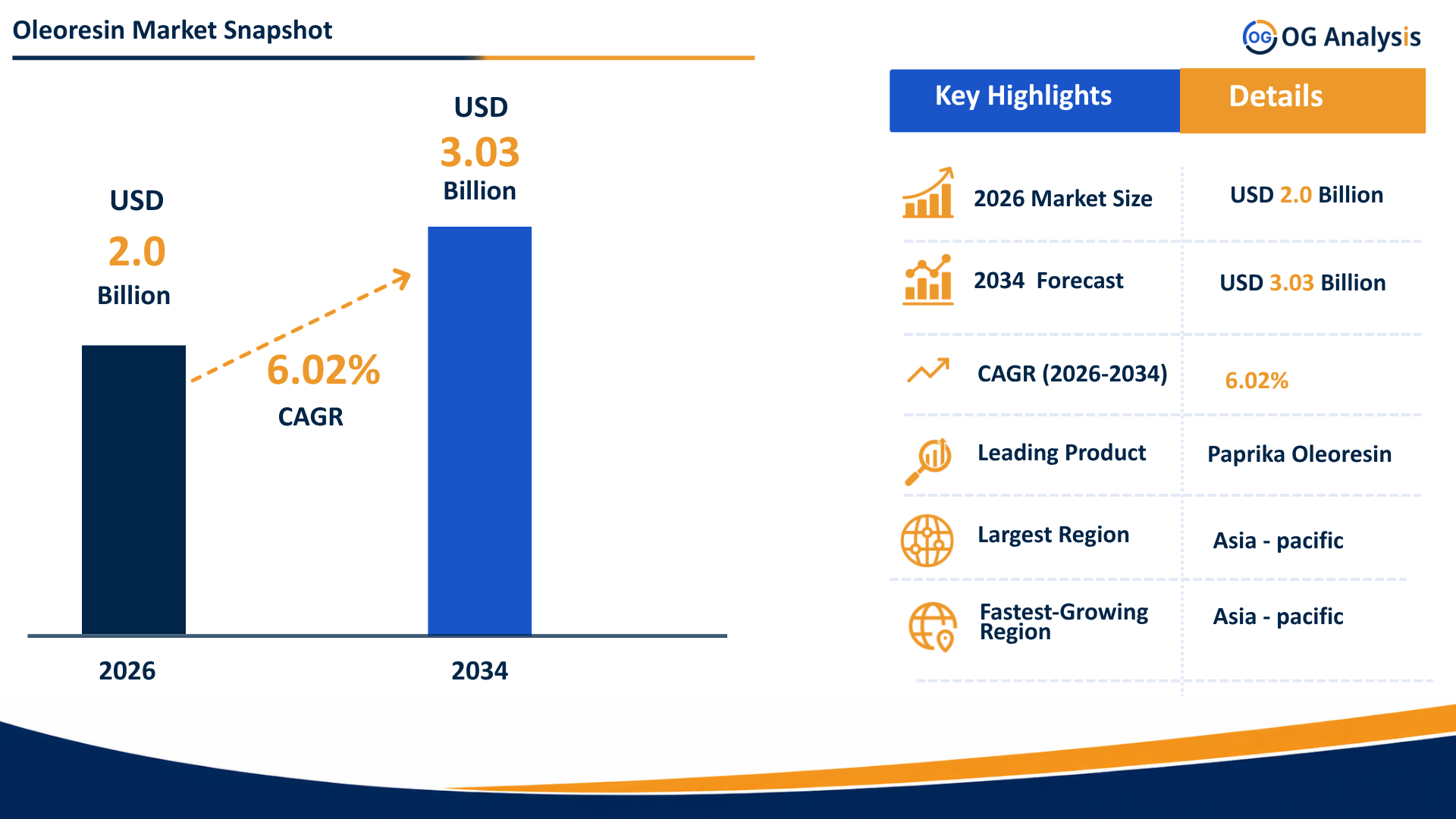
The Oleoresin Market is estimated to be valued at $ 2.0 billion in 2026 and is projected to reach $ 3.03 billion by 2034, expanding at a CAGR of 6.02% from 2026 to 2034.
Oleoresins are concentrated extracts derived from spices, herbs, seeds, and botanicals, containing volatile oils, resinous compounds, color pigments, aroma compounds, and flavor-active ingredients. They are widely used in processed foods, sauces, snacks, meat products, seasonings, beverages, nutraceuticals, pharmaceuticals, cosmetics, fragrances, and animal feed. Market growth is supported by rising demand for natural flavors, clean-label ingredients, ethnic cuisines, convenience foods, botanical extracts, and standardized spice-based formulations. Oleoresins offer advantages over whole or ground spices because they provide consistent flavor, color intensity, longer shelf life, easier handling, reduced microbial risk, and better storage efficiency. Product innovation is focused on paprika, capsicum, black pepper, turmeric, ginger, garlic, onion, seed spice, and herbal oleoresins for food, health, and personal care applications.
Get the Complete Analysis :
https://www.oganalysis.com/industry-reports/oleoresin-market
Get Your Free Sample Report for In-Depth Market Insights :
https://www.oganalysis.com/industry-reports/oleoresin-market/free-sample
1. What is the latest trend in the Oleoresin Market?
The latest trend is the growing use of oleoresins as natural flavoring, coloring, and functional ingredients in processed foods and clean-label formulations.
Food manufacturers are replacing synthetic additives and inconsistent ground spices with standardized botanical extracts.
Demand is increasing for paprika, capsicum, turmeric, ginger, and black pepper oleoresins in seasonings, sauces, snacks, meat products, and beverages.
Nutraceutical and pharmaceutical applications are also expanding due to interest in plant-derived bioactive compounds.
2. What are the key challenges in the Oleoresin Market?
Key challenges include raw spice price volatility, seasonal crop availability, supply-chain disruptions, extraction cost, and quality consistency.
Oleoresin production depends heavily on agricultural raw materials that can be affected by weather, pests, crop yields, and global trade conditions.
Manufacturers must control solvent residues, color strength, pungency, purity, microbial safety, and regulatory compliance.
Price-sensitive food processors may also compare oleoresins with essential oils, natural flavors, synthetic colors, and ground spices.
3. What is the major driving factor for the Oleoresin Market?
The major driving factor is rising demand for natural, concentrated, and standardized ingredients in food and beverage formulations.
Oleoresins help manufacturers deliver consistent taste, aroma, color, and seasoning performance across large production batches.
Growth in ready meals, sauces, snacks, processed meat, ethnic foods, and quick-service restaurant supply chains is strengthening demand.
Increasing consumer preference for clean-label and plant-derived ingredients is further supporting market expansion.
4. What is the major segment in the Oleoresin Market and why?
Paprika oleoresin is a major product segment because it is widely used as a natural coloring and flavoring ingredient in food and beverages.
It provides attractive red-orange color, mild flavor, and strong formulation utility in sauces, seasonings, snacks, meat products, and processed foods.
Capsicum, black pepper, turmeric, ginger, and seed spice oleoresins are also important due to their pungency, aroma, color, and functional positioning.
Food and beverages remain the leading application segment because oleoresins are extensively used in flavor, color, and seasoning systems.
5. Which application or end-user is driving more demand?
Food and beverage manufacturers are driving the strongest demand for oleoresins.
Snack producers, sauce makers, meat processors, seasoning companies, beverage brands, bakery producers, and convenience food manufacturers use oleoresins for consistent taste and color.
Nutraceutical, pharmaceutical, cosmetic, fragrance, and animal feed companies also contribute to demand through botanical ingredient applications.
Demand is strongest where manufacturers need standardized spice intensity, cleaner labeling, and stable product performance.
6. Which region offers the highest growth potential and why?
Asia Pacific offers strong growth potential due to large spice production, expanding food processing, rising packaged food consumption, and growing nutraceutical demand.
India, China, Indonesia, Vietnam, Thailand, and other spice-producing countries are important sourcing and processing hubs.
Europe remains a major market due to demand for natural ingredients, ethnic cuisines, processed foods, and clean-label formulations.
North America is supported by strong demand for convenience foods, natural flavors, dietary supplements, and ethnic food products.
7. What strategies are major companies adopting in the market?
Major companies are focusing on raw material sourcing, integrated extraction facilities, standardized grades, clean-label positioning, and application-specific blends.
They are improving extraction efficiency, color strength, pungency control, solvent management, traceability, and food-safety compliance.
Suppliers are also expanding paprika, capsicum, turmeric, black pepper, ginger, garlic, onion, and herbal oleoresin portfolios.
Partnerships with spice growers, food manufacturers, nutraceutical brands, and flavor houses are becoming important for market expansion.
8. What are the leading companies in the Oleoresin Market?
Leading companies include Synthite Industries, Givaudan, Akay Group, Kancor Ingredients, Kalsec, Plant Lipids, Universal Oleoresins, PT Indesso Aroma, AVT Naturals, Ozone Naturals, Gazignaire, Asian Oleoresin Company, Bioprex Labs, TMV Group, and Chenguang Biotech Group.
These companies compete through extraction expertise, raw material sourcing, product standardization, color and flavor strength, regulatory compliance, and global supply reliability.
Integrated suppliers with strong spice procurement networks and application-development support are better positioned in food, beverage, nutraceutical, and flavor applications.
9. Why are oleoresins strategically important for food and ingredient manufacturers?
Oleoresins are strategically important because they provide concentrated, consistent, and easy-to-use spice and herb functionality.
They help manufacturers reduce storage space, improve batch consistency, control flavor intensity, and simplify formulation compared with whole spices.
For food brands, oleoresins support clean-label positioning, natural color development, and differentiated flavor profiles.
For ingredient suppliers, they create value-added opportunities beyond raw spice trading.
10. What is the future outlook for the Oleoresin Market?
The market outlook remains positive as food, beverage, nutraceutical, cosmetic, and pharmaceutical companies increase their use of botanical extracts.
Future growth will be supported by clean-label foods, ethnic cuisines, natural colors, functional ingredients, and demand for standardized spice extracts.
Paprika, capsicum, turmeric, black pepper, ginger, and seed spice oleoresins are expected to remain important product categories.
Companies offering reliable sourcing, consistent quality, traceability, regulatory support, and application-specific oleoresin solutions are expected to gain market share.
Browse Related Reports
https://www.oganalysis.com/industry-reports/private-label-food-and-beverages-market
https://www.oganalysis.com/industry-reports/gourmet-salt-market
https://www.oganalysis.com/industry-reports/monosodium-glutamate-msg-market
https://www.oganalysis.com/industry-reports/organic-and-synthetic-lycopene-market
https://www.oganalysis.com/industry-reports/specialty-foods-market
