Paprika Market Outlook 2026–2034: Natural Colorant Demand, Clean-Label Food Trends, Growth Drivers, Leading Companies, and Future Opportunities
The Paprika Market size was valued at $ 615 million in 2026 and worldwide sales of paprika are expected to grow at a CAGR of 5.3% to reach $ 929.5 million by 2034.
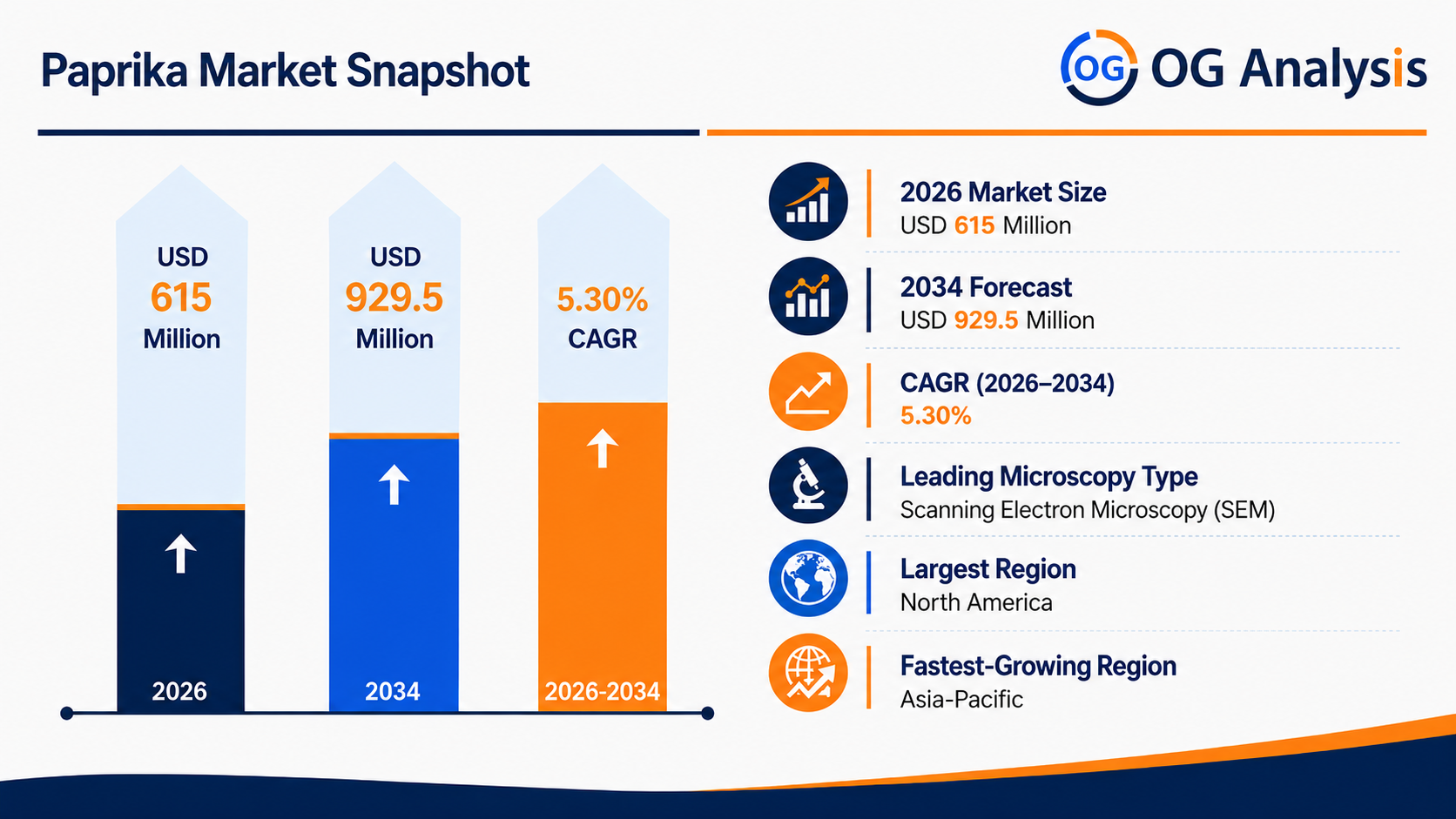
Paprika is a spice derived from dried and ground red pepper varieties and is used as a seasoning, coloring ingredient, flavor enhancer, and natural food colorant. The market includes sweet paprika, hot paprika, smoked paprika, organic paprika, conventional paprika, paprika powder, and paprika oleoresin. Demand is supported by the growth of processed foods, ethnic cuisines, spice blends, ready meals, sauces, snacks, meat products, soups, seasonings, bakery products, and clean-label food formulations. Manufacturers are focusing on stable color intensity, microbial safety, residue control, traceable sourcing, organic certification, and oleoresin extraction to serve food manufacturers, spice brands, foodservice operators, and ingredient formulators.
Get Your Free Sample Report for In-Depth Market Insights :
https://www.oganalysis.com/industry-reports/paprika-market/free-sample
1. What is the latest trend in the Paprika Market?
The latest trend is the rising demand for clean-label paprika powder and paprika oleoresin as natural color and flavor ingredients.
Food manufacturers are using paprika to replace synthetic colorants in snacks, sauces, meat products, cheese, dressings, and ready meals.
Smoked, organic, and origin-specific paprika varieties are gaining attention in premium seasoning and gourmet food products.
Paprika oleoresin is also expanding in processed foods because it offers consistent color, stability, and easier industrial dosing.
2. What are the key challenges in the Paprika Market?
Key challenges include raw material price volatility, crop yield variation, pesticide residue limits, microbial contamination risk, and color stability concerns.
Paprika quality depends heavily on climate, pepper variety, drying methods, storage, and post-harvest handling.
Suppliers must control adulteration, aflatoxin risk, heavy metals, and regulatory compliance across export markets.
Competition from synthetic colors, other natural colorants, and lower-cost spice substitutes can also pressure margins.
3. What is the major driving factor for the Paprika Market?
The major driving factor is increasing demand for natural colors, spice-based flavors, and clean-label food ingredients.
Paprika provides both taste and red-orange color, making it attractive for processed food and seasoning applications.
Growth in convenience foods, ethnic cuisines, quick-service restaurants, and packaged snacks is supporting wider consumption.
Consumer preference for recognizable ingredients is encouraging food brands to use paprika and paprika extracts.
4. What is the major segment in the Paprika Market and why?
Paprika powder represents a major segment because it is widely used in household cooking, spice blends, foodservice, and packaged food formulations.
It is easy to blend, distribute, label, and apply across sauces, soups, rubs, snacks, meats, and ready meals.
Paprika oleoresin is also an important high-value segment because it provides concentrated color and standardized performance.
Food processors prefer oleoresin where consistent shade, stability, and controlled dosing are required.
5. Which application or end-user is driving more demand?
Food and beverage manufacturers are driving the highest demand for paprika across processed foods, seasonings, sauces, snacks, meat products, and ready meals.
Quick-service restaurants, foodservice operators, and spice brands also contribute through seasoning blends and menu innovation.
Paprika is widely used in meat and poultry products, cheese, soups, dressings, savory snacks, and ethnic food preparations.
The ingredient’s dual role as a natural color and flavor enhancer supports demand across multiple food categories.
6. Which region offers the highest growth potential and why?
Europe remains an important market because of strong paprika consumption, ethnic cuisine demand, natural ingredient adoption, and established food processing industries.
Hungary and Spain are historically important paprika markets, while Germany, the UK, and France support strong processed food and seasoning demand.
Asia Pacific offers strong growth potential due to large spice production, expanding packaged food manufacturing, and rising demand for natural colorants.
North America is also growing as consumers adopt ethnic flavors, clean-label products, and premium seasonings.
7. What strategies are major companies adopting in the market?
Major companies are focusing on traceable sourcing, color standardization, clean-label positioning, organic grades, and value-added oleoresin products.
Suppliers are investing in quality control, microbial reduction, residue testing, and stable extraction technologies.
Companies are developing application-specific paprika grades for snacks, sauces, meats, dairy, and seasoning blends.
Partnerships with growers, food processors, spice brands, and natural color formulators are becoming increasingly important.
8. What are the leading companies in the Paprika Market?
Leading companies include McCormick & Company, Olam Food Ingredients, Kalsec, Synthite Industries, Plant Lipids, Sensient Technologies, Döhler, Givaudan, Layn Natural Ingredients, Naturex, Universal Oleoresins, Chenguang Biotech Group, Everest Food Products, Badia Spices, and The Spice House.
These companies compete through sourcing strength, flavor expertise, color consistency, extraction capability, product safety, and customer formulation support.
Oleoresin suppliers hold strong positions in industrial food coloring and flavoring applications.
Spice brands compete through quality, origin, freshness, retail distribution, and premium seasoning portfolios.
9. Why is paprika strategically important for food manufacturers?
Paprika is strategically important because it combines color, flavor, natural positioning, and broad application flexibility.
It helps food manufacturers improve visual appeal while supporting clean-label and recognizable ingredient claims.
Paprika powder and oleoresin can be used across snacks, sauces, meats, soups, dressings, cheese, and convenience foods.
For brands, it supports differentiation in ethnic, spicy, smoked, premium, and naturally colored product lines.
10. What is the future outlook for the Paprika Market?
The market outlook remains positive as natural colors, ethnic cuisines, clean-label foods, and convenience meals continue to expand.
Future growth will be supported by paprika oleoresin, organic paprika, smoked paprika, premium spice blends, and improved supply-chain traceability.
Quality control, residue compliance, climate-resilient sourcing, and stable color performance will remain key success factors.
Companies offering consistent quality, safe supply, strong color performance, and application support are expected to gain market share.
Browse Related Reports
https://www.oganalysis.com/industry-reports/specialty-foods-market
https://www.oganalysis.com/industry-reports/dehydrated-onions-market
https://www.oganalysis.com/industry-reports/bouillon-cube-market
https://www.oganalysis.com/industry-reports/private-label-food-and-beverages-market
https://www.oganalysis.com/industry-reports/processed-chicken-market
Stay Connected With Us
