Starch and Starch Derivatives Market Outlook 2026–2034: Modified Starch Demand, Clean-Label Ingredients, Growth Drivers, Leading Companies, and Future Opportunities
The Starch and Starch Derivatives Market is estimated to be valued at $ 85.05 billion in 2026 and is projected to reach $ 120.95 billion by 2034, expanding at a CAGR of 4.5% from 2026 to 2034.
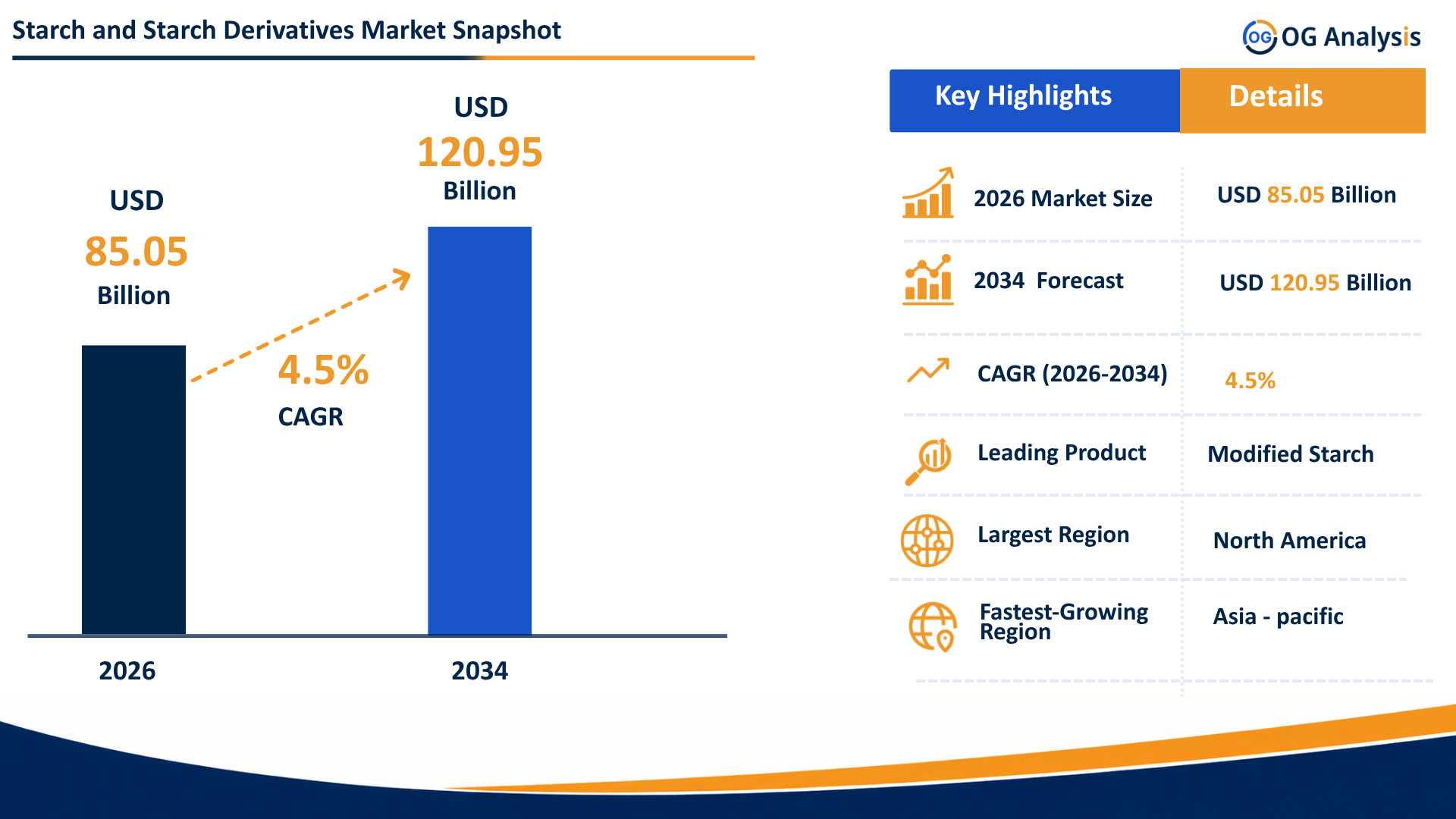
Starch and starch derivatives are carbohydrate-based ingredients derived from corn, wheat, potato, tapioca, cassava, and other botanical sources. They are widely used as thickeners, stabilizers, binders, sweeteners, texturizers, emulsifiers, film-forming agents, excipients, adhesives, and fermentation substrates across food, beverage, pharmaceutical, paper, textile, animal feed, cosmetics, and industrial applications. Market growth is supported by rising processed food consumption, demand for clean-label ingredients, growth in bakery and convenience foods, expanding pharmaceutical excipient use, and increasing adoption of starch-based adhesives and biodegradable materials. Modified starches are gaining strong attention due to their functionality in texture improvement, freeze-thaw stability, viscosity control, shelf-life enhancement, and formulation performance. Starch derivatives such as glucose syrup, maltodextrin, cyclodextrin, sorbitol, dextrin, and high-fructose syrup remain important across sweeteners, nutrition, pharmaceuticals, and industrial formulations.
Get the Complete Analysis :
https://www.oganalysis.com/industry-reports/starch-and-starch-derivatives-market
Get Your Free Sample Report for In-Depth Market Insights :
https://www.oganalysis.com/industry-reports/starch-and-starch-derivatives-market/free-sample
1. What is the latest trend in the Starch and Starch Derivatives Market?
The latest trend is the rising use of clean-label, functional, and specialty starches in food and beverage formulations.
Manufacturers are developing native and modified starches that improve texture, stability, viscosity, mouthfeel, and shelf life.
Demand is also increasing for resistant starch, maltodextrin, starch-based sweeteners, and bio-based packaging inputs.
Food reformulation, digestive health positioning, biodegradable materials, and sustainable adhesives are shaping product innovation.
2. What are the key challenges in the Starch and Starch Derivatives Market?
Key challenges include raw material price volatility, crop supply fluctuations, energy cost, regulatory pressure, and competition from alternative hydrocolloids and sweeteners.
Starch production depends heavily on corn, wheat, potato, and cassava supply, which can be affected by weather, trade policies, and agricultural input costs.
Manufacturers must manage quality consistency, viscosity performance, purity, moisture control, microbial safety, and labeling requirements.
Clean-label demand can also create pressure on chemically modified starches in selected food applications.
3. What is the major driving factor for the Starch and Starch Derivatives Market?
The major driving factor is rising demand for cost-effective, versatile, and functional ingredients in processed food and industrial applications.
Starch and its derivatives help improve texture, thickness, sweetness, stability, binding, and moisture retention across many formulations.
Growth in bakery, confectionery, dairy, sauces, soups, ready meals, beverages, paper, adhesives, and pharmaceuticals is strengthening demand.
The shift toward plant-based and bio-based materials is also supporting wider use in packaging, textiles, and biodegradable products.
4. What is the major segment in the Starch and Starch Derivatives Market and why?
Modified starch is a major product segment because it provides enhanced stability, viscosity control, thickening, binding, and texture improvement.
It is widely used in food, pharmaceuticals, paper, textiles, cosmetics, and industrial applications where native starch performance may be limited.
Glucose syrup and high-fructose syrup are also important due to their broad use in sweeteners, beverages, confectionery, bakery, and processed foods.
Corn remains a major source due to high availability, established processing infrastructure, and broad industrial use.
5. Which application or end-user is driving more demand?
Food and beverages are driving the strongest demand for starch and starch derivatives.
Bakery producers, confectionery manufacturers, dairy brands, beverage companies, sauce makers, snack producers, and convenience food manufacturers use starch-based ingredients extensively.
Pharmaceutical companies use starch derivatives as binders, disintegrants, fillers, stabilizers, and drug-delivery excipients.
Paper, packaging, textiles, adhesives, animal feed, cosmetics, and biofuel producers also contribute to market growth.
6. Which region offers the highest growth potential and why?
Asia Pacific offers strong growth potential due to expanding food processing, rising packaged food consumption, growing paper and textile industries, and increasing demand for bio-based materials.
China, India, Thailand, Indonesia, Vietnam, and Japan are important markets due to large agricultural bases and industrial starch usage.
North America remains a major market due to corn-based starch production, food processing, sweeteners, pharmaceuticals, and industrial applications.
Europe is supported by clean-label food trends, specialty starch innovation, sustainable packaging, and strong demand from food and paper industries.
7. What strategies are major companies adopting in the market?
Major companies are focusing on specialty starches, clean-label solutions, resistant starch, plant-based ingredients, and customized formulation support.
They are improving processing efficiency, raw material sourcing, traceability, sustainability, and application-specific starch functionality.
Suppliers are expanding portfolios across modified starch, native starch, glucose syrup, maltodextrin, cyclodextrin, dextrin, and starch-based sweeteners.
Strategic consolidation is also visible, with Ingredion agreeing to acquire Tate & Lyle to strengthen specialty food and beverage ingredient capabilities.
8. What are the leading companies in the Starch and Starch Derivatives Market?
Leading companies include Cargill, Archer Daniels Midland Company, Ingredion, Tate & Lyle, Roquette Frères, AGRANA, Avebe, Tereos, Grain Processing Corporation, Emsland Group, Global Bio-Chem Technology Group, SPAC Starch Products, Gujarat Ambuja Exports, Südstärke, and KMC.
These companies compete through raw material access, processing scale, product functionality, specialty starch portfolios, food-grade quality, technical support, and global distribution.
Large integrated starch producers benefit from corn, wheat, potato, and cassava processing networks.
Specialty ingredient suppliers compete through clean-label starches, texture systems, pharmaceutical excipients, and application-specific solutions.
9. Why are starch and starch derivatives strategically important for food and industrial manufacturers?
Starch and starch derivatives are strategically important because they provide texture, stability, sweetness, binding, thickening, and processing functionality at scale.
They help food manufacturers improve product consistency, mouthfeel, shelf life, and cost efficiency across large production batches.
For industrial users, starch supports adhesives, paper strength, textile sizing, fermentation, biodegradable materials, and pharmaceutical formulations.
Their plant-based origin also makes them important in sustainability-focused product development.
10. What is the future outlook for the Starch and Starch Derivatives Market?
The market outlook remains positive as demand grows for processed foods, clean-label ingredients, functional nutrition, pharmaceutical excipients, and bio-based industrial materials.
Future growth will be supported by modified starch, resistant starch, maltodextrin, glucose syrup, cyclodextrin, starch adhesives, and biodegradable packaging inputs.
Food reformulation, e-commerce packaging, sustainable materials, and pharmaceutical manufacturing are expected to create additional opportunities.
Companies offering reliable sourcing, consistent quality, clean-label innovation, technical support, and diversified starch derivative portfolios are expected to gain market share.
Browse Related Reports
https://www.oganalysis.com/industry-reports/customized-premixes-market
https://www.oganalysis.com/industry-reports/food-traceability-market
https://www.oganalysis.com/industry-reports/flexible-paper-packaging-market
https://www.oganalysis.com/industry-reports/paper-and-paperboard-packaging-market
https://www.oganalysis.com/industry-reports/cold-water-swelling-starch-market
